We build chatbots, document processing flows and classification automations that take repetitive work off your team's plate, integrated directly into the systems you already use.
From a customer support chatbot to automatic invoice processing or ticket routing, we start from a real process in your company, not a generic demo.
From customer support to invoices and internal reports, here are the types of AI automation we build most often. Each one starts from a real process inside your company, not a generic demo.
Answers frequently asked questions automatically on your website or WhatsApp, and hands off to a teammate whenever the question goes beyond what it can solve.
We extract data from invoices and scanned documents and feed it automatically into your ERP or accounting software, without manual field-by-field copying.
The AI reads the content, identifies intent and urgency, then sends the message straight to the right department, with no manual triage.
For large catalogs, the AI generates consistent descriptions starting from technical specs, and a person reviews them before publishing.
AI agents that fill in fields, summarize interactions or flag anomalies directly inside the system your team already uses.
Transcription and summarization of support calls or conversations, saved automatically into your CRM, no more manual notes after every call.
We automate recurring reports, KPI monitoring and automatic alerts whenever an important threshold gets crossed.
Contracts, handwritten orders or photographed receipts get turned into structured data, ready to feed into your systems.
Automatic review of reviews, comments or images uploaded by customers, with clear flagging of what needs human attention.
Standard quotes, order status or delivery questions, with a reply generated automatically based on the context of the incoming message.
The AI spots duplicates, fixes broken formats and fills in missing fields whenever you migrate or sync data between systems.
Instant answers for your team, based on internal documentation (procedures, policies, code), instead of digging through dozens of files.
We don't ship an AI experiment. Every automation starts from a real process, with a clear human checkpoint wherever the decision actually matters.
We analyze your team's current workflow and pinpoint the repetitive steps, the data involved, and exactly where the decision needs to stay human.
We connect the automation to your ERP, CRM, email or online store through APIs, so data lives in one place instead of being duplicated across two systems.
Depending on the case, we use a general-purpose AI model, a model tuned on your data, or plain rule-based logic, wherever simple rules do the job better than AI.
After launch, we measure accuracy, identify where the AI gets it wrong, and fix the rules or the model itself, not just the individual case that came up.
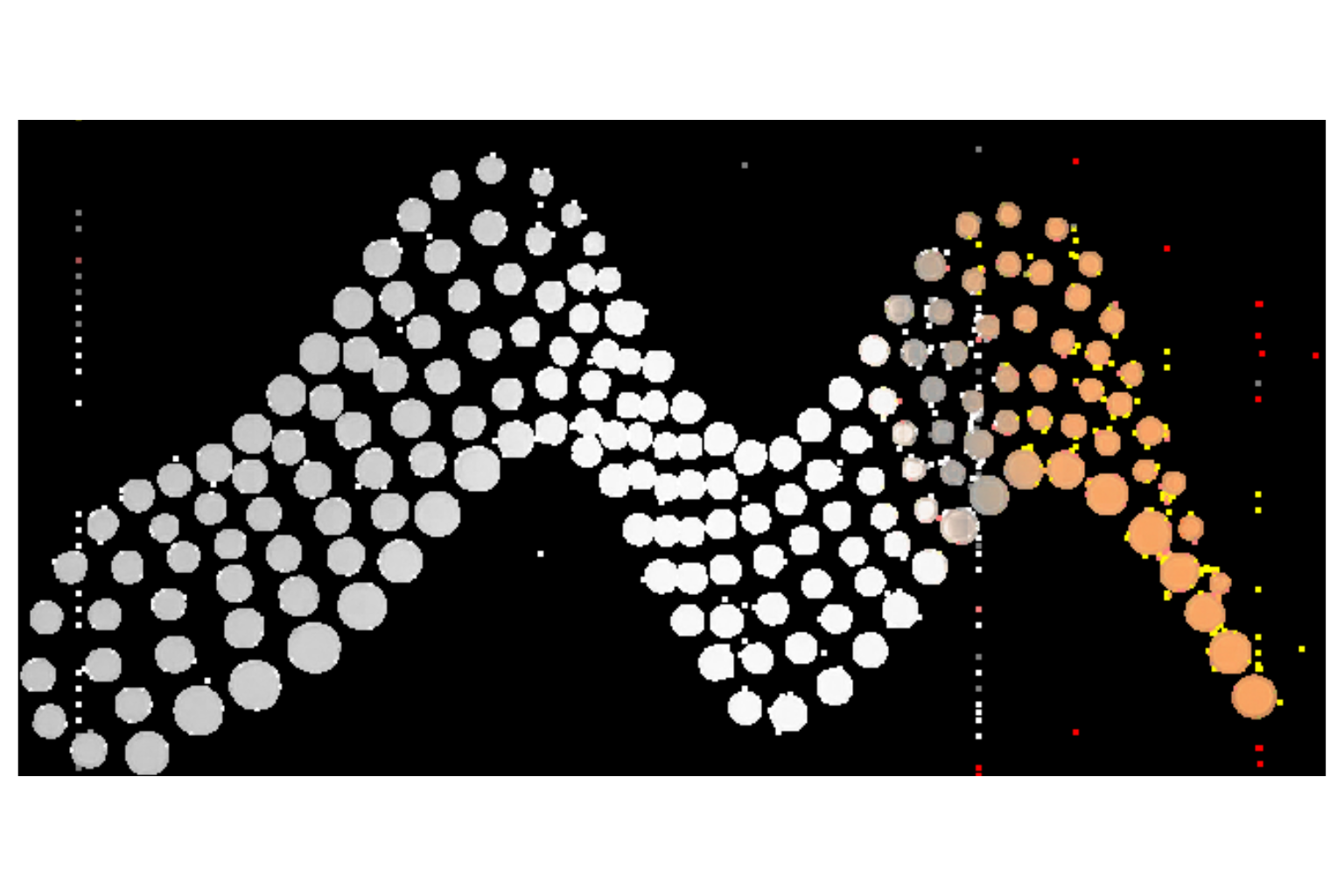
A concrete example of a flow that applies to any classification and rules-based process: the task arrives, the AI interprets and routes it, and a human confirms wherever the decision matters.
From the message received to the reply sent, every step stays visible and auditable, not a black box.
Some of the companies we've built software and integrations for, including automation components.
We most often automate repetitive, rule-based processes: answering frequently asked questions, processing invoices and documents, classifying and routing emails or support tickets, generating product descriptions for large catalogs. If a process can be described step by step, it can usually be automated, at least in part.
It depends on the risk. For low-impact tasks, such as routing or suggesting a reply, the AI can act on its own. For decisions with financial impact or a direct effect on the customer relationship, we keep a human confirmation step, agreed with you before launch.
It varies by process type and by the quality of the input data. We do not promise 100% accuracy: we measure results after launch and adjust the automation wherever repeated errors appear.
We use AI models through secure APIs, without training public models on your data. We discuss exactly what data moves and where before implementation starts.
A simple automation, such as email classification, can be ready in 2 to 3 weeks. A more complex flow, with ERP or CRM integration, usually takes 4 to 8 weeks.
Every automation has a human review point for important cases, plus logs for every automated action. When we spot a recurring error, we fix the rules or the model, not just the individual case.
Yes. We connect the automation through APIs to the systems you already use: ERP, CRM, your online store, email. You don't need to replace existing systems to start using the automation.
Pick a time for a call or write to us directly. We'll look at your process and tell you clearly if and how it can be automated with AI.
or by email: contact@maxdev.ro